
 SOLURIL contains potassium-magnesium citrate (tetra-potassium-magnesium dicitrate).
Soluril provides approximately 5 mEq citrate, 3.3 mEq potassium, and 1.7 mEq magnesium.Potassium-magnesium citrate is a source of bioavailable K, Mg, and citrate.
SOLURIL contributes to the maintenance of:
 Acid-base balance Healthy bones and teeth
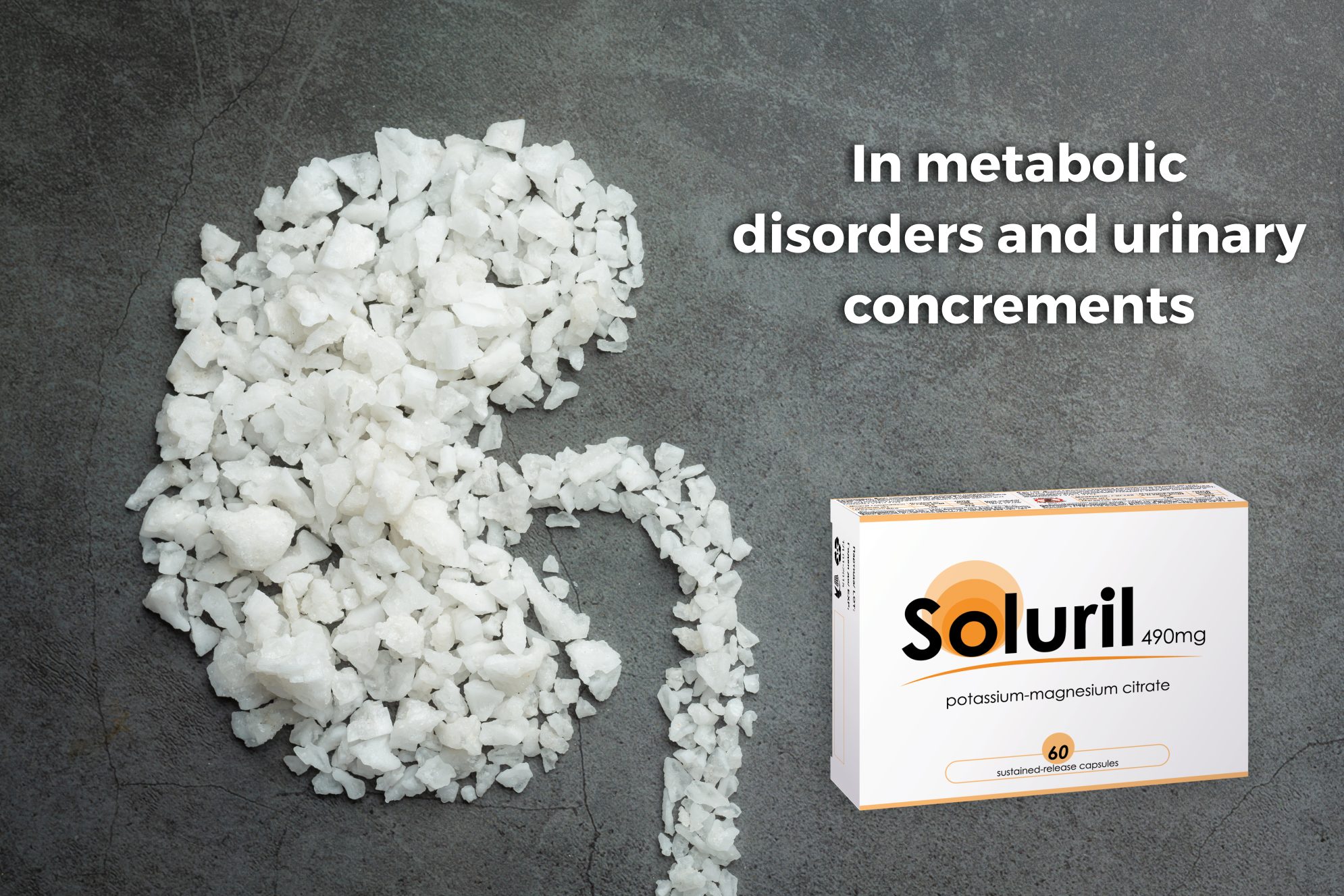
Each capsule contains potassium-magnesium citrate 490 mg

According to the European Food Safety Authority (EFSA), the benefits of potassium, magnesium, and citrate are:
Potassium is required for: Muscle function Maintaining healthy blood pressure Supports nerve function Magnesium is needed for: Electrolyte balance Muscle function The nervous system Metabolism and absorption of energy Protein synthesis Cell division Normal blood clotting The construction and maintenance of healthy bones and teeth Citrates help: Acid-base balance Healthy bones

Safe levels of each containing element.
* Recommended daily allowance according to EU COMMISSION DIRECTIVE 2008/100/EC
Dose
In acidosis – it is recommended to start with 1-2 capsules in the evening and, if a stronger effect is needed, to reach 3 tablets 2 times a day.For kidney stones – it is recommended to take 3 capsules 2 times a day until the stones are expelled in the urine.If prolonged intake is needed, the same or reduced dose is possible.Monitoring with a urine pH test strip is necessary to avoid alkalization above normal.
Research
Potassium magnesium citrate effectively prevents calcium oxalate stone re-formation by 85%.
Magnesium inhibits the crystallization of calcium oxalate in urine. Magnesium inhibits the absorption of dietary oxalate through the intestinal lumen. As a mixed salt, like potassium citrate, potassium-magnesium citrate reduces calcium stone formation by 90%, having better gastric tolerance.
Taking potassium-magnesium citrate is an effective measure against the increased risk of kidney stones. Rest bed rest results in a rapid increase in urinary calcium excretion of approximately 50 mg per day. Compared with the placebo, despite an increase in urinary calcium concentration, calcium oxalate concentration decreased due to the chelation of calcium by citrate. Decreased concentration of undissociated uric acid due to a significant increase in urine pH.

Three main conditions control the potential for urate stone formation: quantitative excretion of uric acid; urine volume determining the concentration of uric acid in the urine and pH. The most important factor in urate stone formation is urine pH. Therefore, the goal is to achieve a pH consistently above 6-6.5 by alkalinization. Administration of alkali is titrated appropriately by pH paper until a steady state is achieved. Alkalinizing the urine and maintaining consistently high pH values may be the treatment of choice for dissolving and preventing urate kidney stones.
An important inverse relationship has been demonstrated between 24-hour urine pH and the degree of insulin resistance. A progressive decrease in urine pH is associated with an increase in the metabolic functions affected. The more acidic the urine, the more patients with metabolic syndrome have a greater propensity for urate nephrolithiasis.